You spent hours perfecting your resume. You meticulously listed your education, detailed your work history, chosen a sleek template with stylish columns and icons, and hit “Apply.” Then… silence. No phone call. No interview. Not even an automated rejection email. Weeks pass, and your application simply vanishes into a digital void.
What happened? Did the hiring manager review your application and decide you weren’t qualified?
The truth is: a human being probably never saw your CV.
Your application was likely killed in seconds by an invisible gatekeeper—an Applicant Tracking System (ATS). If you are creating your CV manually without understanding how ATS algorithms work, you are gambling with your career.
What is an ATS and Why Does It Control Your Fate?
An Applicant Tracking System is a software application designed to automate the initial recruitment process. Companies receive hundreds—sometimes thousands—of applications for a single job opening. HR managers simply do not have the time to read every document manually.
Instead, companies deploy ATS software (such as Taleo, Workday, Greenhouse, or Lever) to scan, analyze, rank, and filter incoming resumes.
- Over 98% of Fortune 500 companies use ATS software ( according to research by Jobscan ).
- Over 75% of mid-sized and large international employers rely on ATS filters ( based on global HR studies by KellyOCG ).
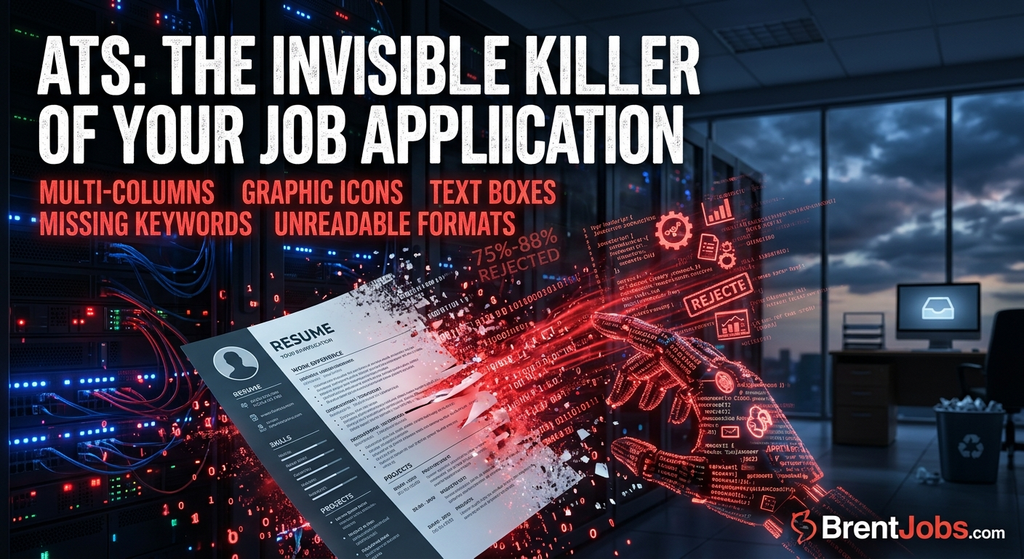
- 75% to 88% of all resumes are automatically rejected by the ATS before a human recruiter ever lays eyes on them ( especially high for graphic, multi-column, or Canva-designed templates, as documented by TopResume and Preptel ).
If your document fails to pass the robot’s strict rules, it is instantly discarded. You become part of the overwhelming majority of qualified professionals whose applications are killed in cold blood.
5 Ways Your DIY CV is Silently Executed by the ATS Robot
If you designed your CV yourself using Microsoft Word, Canva, Photoshop, or a free online template, you may have unintentionally built a document that ATS algorithms cannot read. Here are the most common “fatal flaws”:
1. The Multi-Column & Graphic Trap
Visually stunning templates with two columns, sidebars, charts, skill rating bars, and graphic icons may look impressive to the human eye, but to an ATS scanner, they are an absolute nightmare. Most ATS software parses text from left to right, top to bottom. Multi-column layouts cause the software to merge random lines of text together, turning your career history into complete gibberish.
2. Unreadable File Formats and Elements
- PDFs created as images: If your PDF was saved as a flat image rather than a text-based document, the ATS reads it as a completely blank page.
- Text Boxes & Tables: Information placed inside text boxes, headers, footers, or tables is frequently skipped entirely by ATS parsers. If your contact details are in the header, the system might think you didn’t include an email or phone number!
3. The Keyword Void
ATS algorithms evaluate your resume based on keyword matching. They compare the words in your CV against the exact terms listed in the job description.
- If a job post asks for “Project Management” and your CV says “Led complex initiatives”, the ATS gives you zero points for project management.
- If you use creative job titles like “Marketing Ninja” instead of “Digital Marketing Manager”, the robot assumes you lack relevant experience.
4. Non-Standard Section Headings
Human recruiters might appreciate creative headings like “My Journey” or “What I Do Best”, but ATS software looks for standard, predictable headers: “Work Experience,” “Education,” “Skills,” and “Summary.” Unconventional headings confuse the parser, causing entire sections of your CV to be ignored.
5. Foreign Language & Spelling Disconnects
Applying for a US role with British English spelling (or vice versa) can trigger a silent rejection. If the software is programmed to look for “Analyze” and your CV says “Analyse”, you risk losing valuable match score points.
The Psychological Toll: Why “Ghosting” Happens
The most painful part of the ATS trap is the psychological impact. When job seekers receive no response, they begin to doubt their skills, their qualifications, and their self-worth. They assume they weren’t good enough for the job.
In reality, many of these rejected candidates are highly qualified, skilled, and perfect for the position. Their only crime was presenting their qualifications in a format that a machine couldn’t digest.
How ATS Algorithms Score Your Application
| Factor | What ATS Looks For | What Triggers Rejection |
| Document Layout | Simple, single-column text flow | Tables, columns, graphics, text boxes |
| Header Names | Standard terms (“Work Experience”) | Creative headers (“Where I’ve Been”) |
| Keywords | Exact phrases from the job description | Generic descriptions, missing key terms |
| File Type | ATS-compliant .docx or text-based PDF | Graphic PDFs, PNGs, JPEGs, Canva exports |
| Formatting | Standard bullet points, clean fonts | Custom symbols, icons, progress bars |
How to Defeat the ATS and Land More Interviews
Beating the “invisible killer” isn’t about cheating the system—it’s about presenting your real achievements in an ATS-friendly structure:
- Use a Clean, Single-Column Layout: Ditch heavy graphic designs. Stick to clean, text-driven layouts with standard fonts (Arial, Calibri, Helvetica).
- Tailor Your Keywords for Every Single Job: Carefully review the job description. Naturally integrate the exact technical skills, software names, and industry terms used by the employer into your bullet points.
- Stick to Standard Headings: Use clear, recognized titles like Professional Experience, Education, Key Skills, and Certifications.
- Quantify Your Achievements: Combine keywords with measurable results (e.g., “Managed a $50,000 budget and increased efficiency by 20%”).
- Test Your Document Before Applying: Run your resume through ATS optimization tools or professional review services to ensure your document parses correctly.
Stop Letting a Robot Deny You Your Dream Job
Your career is too important to be cut short by an unreadable PDF or a missing keyword. By taking control of your document formatting and learning how ATS systems evaluate candidates, you can ensure that your application actually reaches the hands of a hiring manager.
Don’t let the invisible killer stop your career momentum. Create, test, and optimize your ATS-ready resume today and start getting the interview callbacks you deserve!
The article was generated by Gemini (Google’s AI).
BrentJobs does not necessarily endorse all statements in this article, particularly those expressed in categorical terms. We are keeping it available because we believe the topic is relevant to job seekers, while reviewing the content for accuracy, balance and clarity.