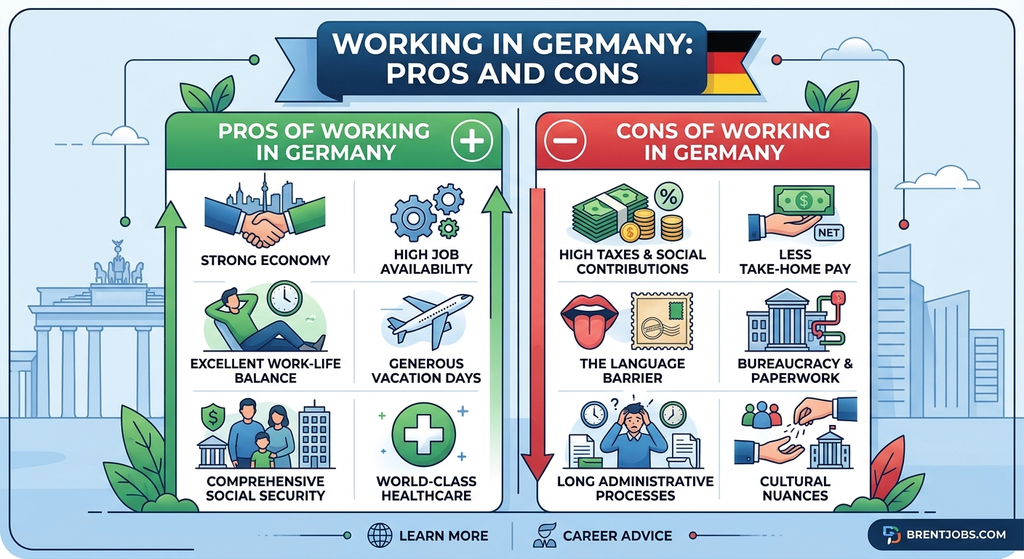
Working in Germany: Pros and Cons Every Job Seeker Should Know
As Europe’s largest economy and a global powerhouse in technology, engineering, manufacturing, and innovation, Germany has long been a top destination for international job seekers. With a strong labor market, excellent social protections, and central positioning within Europe, the country attracts hundreds of thousands of foreign professionals every year.
However, moving to a new country for work involves weighing both the advantages and the potential challenges. To help you decide whether Germany is the right fit for your career journey, here is a comprehensive look at the pros and cons of working in Germany.
The Pros of Working in Germany
1. Strong Economy and Robust Job Market
Germany boasts one of the most stable and resilient economies in the world. Key industries such as automotive engineering, information technology, renewable energy, pharmaceuticals, and finance are constantly searching for skilled talent.
- The Opportunity: Qualified professionals—particularly in STEM fields (Science, Technology, Engineering, and Mathematics) and healthcare—enjoy high job availability and competitive salaries.
- EU Blue Card: Germany offers a streamlined visa pathway via the EU Blue Card for highly skilled non-EU professionals, making legal immigration and long-term residency significantly easier.
2. Excellent Work-Life Balance and Generous Time Off
German workplace culture places a strong emphasis on efficiency and personal time. “Work hard, play hard” is taken seriously, and overtime is generally discouraged unless strictly necessary.
- Paid Vacation: By law, full-time workers are entitled to a minimum of 20 to 25 days of paid annual leave, though most corporate contracts standardly offer 28 to 30 paid vacation days per year.
- Public Holidays: Depending on the federal state (Bundesland), employees enjoy between 9 and 13 public holidays annually.
- Strict Working Hours: The typical workweek is around 35 to 40 hours, and employees are rarely expected to answer emails or phone calls outside of official working hours.
3. Comprehensive Social Security and Healthcare
Germany operates one of the world’s oldest and most effective social safety nets. Employees contribute a percentage of their gross income toward statutory insurance funds, which are matched by their employers.
- Universal Healthcare: Access to high-quality medical care is guaranteed. Statutory health insurance (Gesetzliche Krankenversicherung) covers almost all necessary treatments, medications, and hospital stays.
- Unemployment & Pension Cover: If you lose your job, the state unemployment insurance (Arbeitslosenversicherung) provides up to 60% (or 67% with children) of your previous net salary while you search for new employment.
4. High Standard of Living and Safety
Germany consistently ranks high for overall quality of life. The country offers safe cities, modern public transportation, excellent infrastructure, and vibrant cultural events. Public education—from primary school to world-renowned universities—is virtually tuition-free for all residents.
The Cons of Working in Germany
1. High Taxes and Social Contributions
While the benefits of the German welfare state are immense, they come at a significant cost. Germany has one of the highest tax burdens in the European Union.
- Net vs. Gross Income: Income tax, combined with mandatory contributions for healthcare, nursing care, unemployment, and state pensions, can reduce your gross salary by 35% to 45%, depending on your salary bracket and marital status (Steuerklasse).
- Takeaway: While your gross salary might look large on paper, your net income (take-home pay) will be noticeably lower.
2. The Language Barrier
Although English is widely spoken in major cities like Berlin, Munich, or Frankfurt—especially in tech startups and multinational corporations—daily life and office environments in smaller towns heavily rely on German.
- Career Growth: To truly integrate, advance into leadership roles, or navigate administrative tasks, mastering the German language (at least at a B2 level) is crucial.
- Daily Interactions: Dealing with local authorities, reading contracts, or making local friends can be challenging without basic language skills.
3. Bureaucracy and Administrative Processes
Germany is famous for its strict adherence to structure, paper documentation, and formal procedures (Bürokratie).
- Patience Required: Registering your address (Anmeldung), opening a bank account, obtaining a tax ID, or converting a driver’s license can involve lengthy appointments and significant paperwork.
- Digital Lag: While digital transformation is underway, many government offices still rely heavily on postal mail rather than email or online portals.
4. Cultural Nuances: Directness and Social Integration
German communication style is notoriously direct, pragmatic, and clear. In professional settings, constructive feedback is given openly without excessive sugarcoating, which can sometimes be misinterpreted by newcomers as coldness. Additionally, making close German friends often takes time, as people tend to keep strict boundaries between work life and private life.
Summary Matrix: Is Germany Right for You?
| Category | The Positives (Pros) | The Challenges (Cons) |
| Career & Market | Strong economy, high demand for STEM/Healthcare | Language barrier limits top management roles |
| Income & Taxes | Competitive salaries, strong pensions | High taxes and social contributions (35–45%) |
| Lifestyle | Up to 30 days vacation, great work-life balance | High bureaucracy and paper-heavy processes |
| Family & Living | Free public education, high safety index | Social integration requires time and patience |
Final Verdict: Building Your Career in Germany
Working in Germany offers a highly secure, well-compensated, and balanced career path, especially for those seeking long-term stability and family-friendly social benefits. While high taxes and administrative red tape can feel overwhelming initially, the quality of life and job security far outweigh the drawbacks for most international workers.
If you are prepared to learn the language and adapt to structured working processes, Germany can be an extraordinary place to advance your professional journey.
Looking for your next career move? Explore the latest job opportunities across Europe on BrentJobs today!