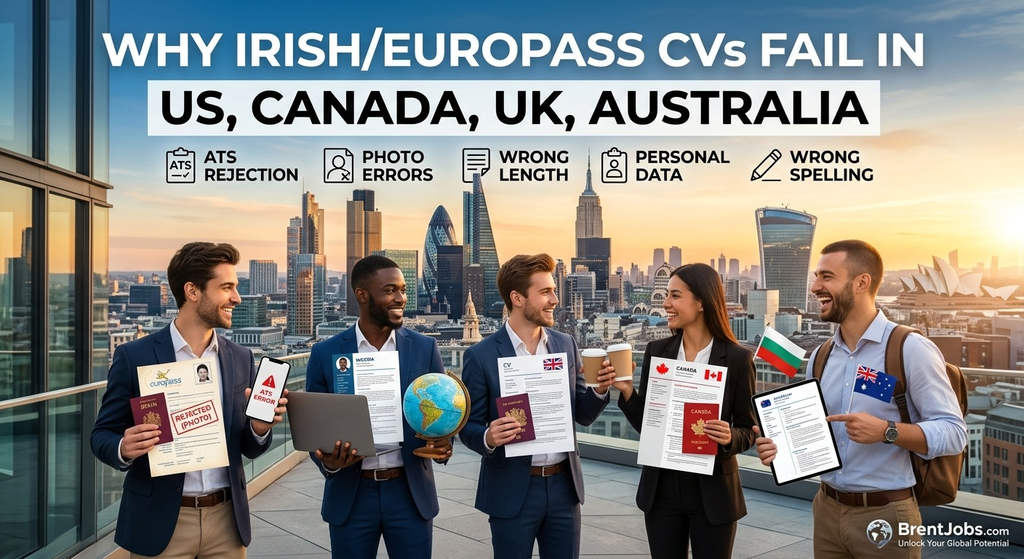
When applying for international jobs, many candidates make the mistake of using a single “universal” document—often an Irish or Europass-style CV—to apply everywhere. However, global recruitment standards are far from uniform. What is considered standard in Ireland will likely result in an instant rejection in the United Kingdom, the United States, Canada, or Australia.
Using inappropriate document formats places your job application in serious jeopardy. Here is why adapting your resume or CV to the exact standards of your target country is essential for international success.
1. The UK Rejection: Europass vs. The British CV
If you are using an Irish CV formatted on the Europass template, sending it to a recruiter in the United Kingdom is one of the quickest ways to get rejected.
- The Brexit Factor & Market Preference: UK employers and recruiters generally dislike Europass CVs. They view them as rigid, visually outdated, and overly bureaucratic. Since Brexit, UK employers strongly favor a modern, tailored British-style CV over standardized European formats.
- Layout and Tone: A standard UK CV is concise (strictly 2 pages), highly professional, and written in British English. It begins with a strong Personal Statement (profile) at the top—something Europass templates lack or handle poorly.
- No Personal Data: Unlike traditional European formats, a UK CV should never include a photograph, nationality, date of birth, or marital status.
2. US vs. Canada: Similar, But Not Identical
While North America broadly uses the term Resume instead of CV, assuming the US and Canadian job markets are identical is another common pitfall.
The United States: The High-Impact, 1-Page Resume
- Length: Strictly 1 page for entry-to-mid level roles (2 pages only for executives with 10+ years of experience).
- Focus: Heavy emphasis on quantifiable metrics and dollars saved or earned (e.g., “Increased sales by 35% within 6 months”).
- Strict Anti-Bias Laws: Including a photo, age, gender, or marital status will cause US HR software or recruiters to discard your application instantly to prevent potential discrimination lawsuits.
Canada: The Competency-Focused Resume
- Length: Usually 1 to 2 pages.
- Key Difference: Canadian resumes heavily feature a dedicated “Core Competencies” or “Highlights of Qualifications” bulleted section at the very top. Canadian employers want to see a direct match between your skills and their job posting immediately.
- Language & Format: Uses Canadian English (a mix of British spelling like colour and US terms) and standard North American letter paper dimensions, rather than A4.
3. Australia: The Detailed Career Story
In Australia, the terms CV and Resume are used interchangeably, but the format differs significantly from both North America and Europe:
- Extended Length: Australian resumes are typically 2 to 4 pages long.
- Granular Detail: Australian recruiters expect comprehensive descriptions of previous roles, including company backgrounds, team sizes, key projects, and explicit lists of daily duties alongside achievements. Sending a compressed 1-page US resume or a rigid Europass CV will make you look underqualified in Australia.
4. The Harsh Truth About ATS (Applicant Tracking Systems)
Here is a reality check every job seeker needs to understand: Before any human recruiter sees your application, a machine decides your fate.
Over 98% of Fortune 500 companies and a vast majority of mid-sized firms in the US, UK, Canada, and Australia use Applicant Tracking Systems (ATS) to screen candidates.
Why Improper Formats Kill Your Application:
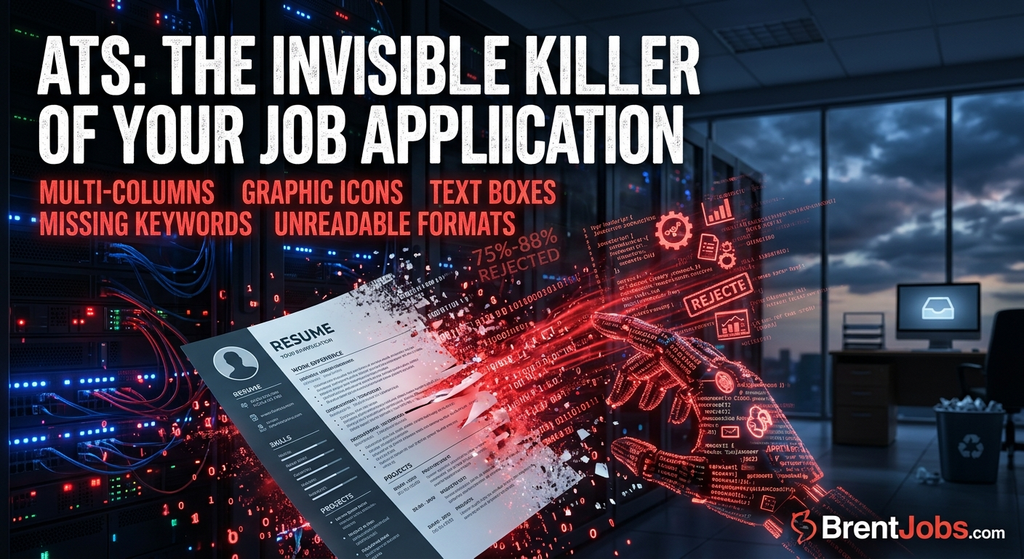
- Unreadable Layouts: Europass templates, multi-column designs, tables, graphics, and text boxes confuse ATS algorithms. When the software cannot read your layout, it converts your CV into unreadable gibberish and assigns you a low match score—leading to automatic rejection.
- Keyword & Spelling Traps: If an American ATS is searching for “Labor Relations” or “Specialized Skills”, and your Irish/UK CV says “Labour Relations” or “Specialised Skills”, the system may fail to register your qualifications.
- The Silent Rejection: Most candidates who get rejected by ATS never even receive an email explaining why. Their application simply disappears into a “digital black hole.”
Country Comparison Matrix
| Country | Preferred Document | Length | Photo Allowed? | Primary Focus / Distinction |
| Ireland | CV / Europass | 2 Pages | Optional | European standards, overview of duties & education |
| United Kingdom | British CV | 2 Pages | NO | Strong Personal Statement, clean design, NO Europass |
| United States | US Resume | 1 Page | NO | Aggressive quantifiable metrics ($ / %), American English |
| Canada | Canadian Resume | 1–2 Pages | NO | “Core Competencies” section, Canadian English, A4 vs Letter |
| Australia | Australian Resume | 2–4 Pages | NO | In-depth career context, detailed project descriptions |
Summary: How to Protect Your Job Application
If you want your international job search to succeed, you must localize your application documents:
- Ditch the Europass completely when applying outside mainland Europe.
- Format for ATS compliance: Use single-column layouts, standard fonts, clear headings, and local language spelling.
- Respect local privacy laws: Remove photos, ages, and personal details for North America, the UK, and Australia.
- Tailor your length: 1 page for the US, 2 pages for the UK/Canada, and up to 3–4 pages for Australia.
Final Thoughts
Your qualifications might be outstanding, but if they are presented in the wrong format, hiring managers will never notice them. Investing the time to adapt your CV or resume to local country standards shows professionalism, cultural intelligence, and respect for the recruitment process.
Take control of your global career today. Upload your localized CV or resume on BrentJobs and land interviews worldwide!
The article was generated by Gemini (Google’s AI).
BrentJobs does not necessarily endorse all statements in this article, particularly those expressed in categorical terms. We are keeping it available because we believe the topic is relevant to job seekers, while reviewing the content for accuracy, balance and clarity.
Please read “ATS: The Invisible Killer of Your Job Application”